I am still working on making this page look OK. I am giving myself crash lessons in HTML on the ru, So bare with me please.Item: Fijian War Club |
||
Notes
|
Resources: citation, repository
|
|
| Manufacture | In Fiji |
|
| Year | Before 1900 |
|
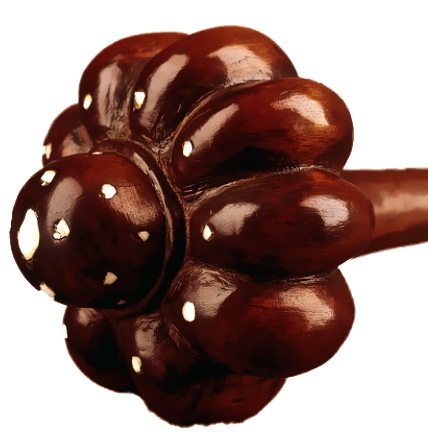
| Physical description: material made of, size, shape, any writing, | Made of wood about 50cms in length. Long handle with a fluted knob at one end. Knob about 10cms in diameter. Down one side is a slit where boar’s teeth were supposedly inserted. | |
Any identifying marks? Monogram, maker’s seal, creaks, breakage, stains |
Has a split down the side which has enlarged over the years due to the wood drying out. | |
What was its function/use? |
It was a killing tool. Used in warfare. The boar’s teeth would have made it lethal | |
| History | Do not know who actually originally owned the club or who brought it to Australia. Great grandfather James Henry Molloy took family to live in Fiji in 1874. He was the Police Inspector in Levuka before he retired. Great Grandfather Frederick William Steel worked for CSR Sugar in Fiji 1894-99. Must have met his future wife then (Charlotte Alicia Molloy). He also had brothers working for same company. |
|
| How is it used now? | Sits in a draw gathering dust | |
| Has it been altered? | No boars teeth, wood drying out splitting, weight has altered due to age not as heavy | |
| Where is it? Current location, who is the caretaker? | Owned by Evelyn Mitchell, Perth, Western Australia | |
| Preservation: Problems? | Needed to have been kept in a controlled climate to preserve it. | |
| Is it common? Rare? One of a kind? | There are all sorts of Fijian war clubs. The Pitt River collection has 71. I do not think it is rare or of monetary value. Due to it seems to be common on the net and its preservation was not diligent. | |
| Images |  |
https://museumvictoria.com.au/fiji/images/mn011767_lg.jpg Short handled club with a fluted head. This is a throwing club used in war, made from the stem and buttress roots of the shrub used in making it. Tattoo designs decorate the handle. Reg. Number: X2220 Acquistion Details: Purchased from H.A. Smith Estate, 1888 Dimensions: L.430mm Diam. handle 25mm Diam.head 110mm MV Collection object |
 |
http://www.greendragonsociety.com/images/Fijian%20War%20Club_10.jpg | |
 |
http://www.new-guinea-tribal-art.com/wp/wp-content/uploads/2011/09/Ula-Tavatava-263x300.jpg A common type of Ula with flanges or lobes on the head of the club Ula Fijian War Club Ula were made for throwing at an enemy and often a Fijian warrior would have several either tucked into his belt or close to hand. It is for this reason they are the most common type of Fijian war club on the market. Ula come in many different forms. |
|
Research for 30 June 2016
Article edited with the free HTML composer software.
| Comments | Resources: citation, repository |
| Images do not resemble the object I have | Rethinking Pitt-Rivers, Fijian Clubs: http://web.prm.ox.ac.uk/rpr/index.php/object-biography-index/1-prmcollection/816-fijian-clubs/index.html |
| Tells of the Fijian war culture with images | Green Dragon Society: Warriors of the World, Fiji Warriors http://www.greendragonsociety.com/Warriors/default.asp |
| A club was the most cherished weapon of the Fijian warrior. It was designed and made for specific purposes and there are approximately thirty distinct and diverse types of native weapons used by the Fijians. Native weapons that had been successfully use to kill were either inlayed with human teeth or by the cutting of notches on the grip. A club use to kill many enemies was believed to have a life power of its own or mana. | Native Weapons: Fijian War Club. http://www.new-guinea-tribal-art.com/wp/index.php/2011/10/05/native-weapons/ |



No comments:
Post a Comment